
Research
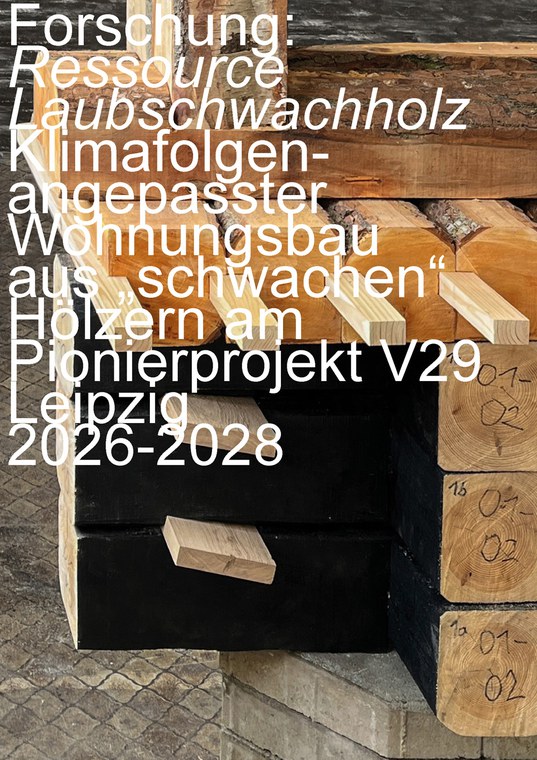
Research project “Small-Diameter Hardwood as a Resource: Development and Testing of Material-Driven Design and Construction Methods for Multi-Story Residential Buildings Adapted to Climate Change Impacts.” Funded by the German Federal Environmental Foundation (DBU). In cooperation with WKC, ee concept , and the Saxony State Forestry Agency (Sachsenforst), Taura Forest District; testing as part of the V29 collective construction project in Leipzig. Project duration: November 2026–November 2028.
Climate-driven forest restructuring is not only altering the species composition of our forests. As the balance shifts from coniferous to deciduous timber, the forms and properties of the timber suitable for construction are also changing. Whilst established timber construction largely relies on straight, well-defined and kiln-dried coniferous timber, this forest restructuring is also bringing deciduous timber logs into focus – logs that are thin, crooked or have grown irregularly, and which until now have scarcely been considered as structural timber. These include what is known as ‘weak deciduous timber’. Curvature, cross-section and knots vary from log to log; when used ‘wet’, the timber continues to change even after installation due to natural drying, shrinkage and cracking. The research project investigates how a common structural and spatial order can emerge from these diverse and changing elements. A specific case study is the socio-ecological collective building project V29 in Leipzig. In this multi-storey residential building, this approach to working with ‘weak hardwood’ is being pioneered under current planning, approval and construction conditions.