
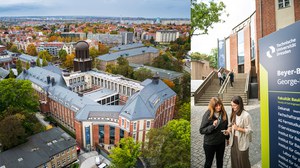
The institute introduces itself
For more than 100 years the subject 'solid structures' has been taught at the TU Dresden. At the moment four professorships belong to our institute. All studies and research within the institute are focused on experimentation on reinforced concrete in all its various forms. In the field of teaching, we collaborate with many partners of the construction industry. Together we make research findings become part in construction projects.


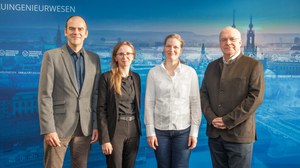 © Stefan Gröschel
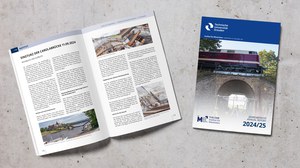
Building Bridges: Research, Innovation, and Responsibility
The years 2024 and 2025 were filled with energy, innovation, and significant developments for the IMB—developments that demonstrated in many ways just how central our Institute is to research, teaching, and social progress.
A truly shocking moment was the collapse of a section of the Carola Bridge on September 11, 2024, in which, fortunately, no one was injured. Colleagues at the IMB—led by Prof. Steffen Marx—were deeply involved in investigating the causes. In the aftermath, there was a significant increase in requests for structural inspections and expert opinions in the form of lectures, interviews, expert reports, and publications on the topics of bridge infrastructure and stress-
crack corrosion.
Of course, there were also scientific highlights once again. In July 2024, the Collaborative Research Center/Transregio 280 “Design Strategies for Material-Minimized Carbon-Reinforced Concrete Structures” entered its second funding phase. Together with RWTH Aachen University and other consortium partners, we will continue to advance basic research into resource-efficient, sustainable construction methods over the next four years—a true flagship for carbon concrete research in Germany. Another highlight was the DFG’s approval of the CARE Cluster of Excellence—Climate-Neutral and Resource-Efficient Construction—which was initiated under the leadership of Viktor Mechtcherine (Institute of Construction Materials at TU Dresden) and in which the IMB is participating.
Additional innovative and forward-looking projects were also successfully secured. A prime example is the HyBridGen—Hybrid Bridge Generator project, funded by the Federal Ministry of Transport (BMV), which kicked off in April 2024. The goal here is to automatically generate AI- and data-driven, people-friendly bridge designs; a pilot application is planned for the Central German region.
Our early-career researchers also achieved numerous successes. For example, at the Dresden Construction Day in May 2024, two theses supervised at the Institute of Concrete Structures received awards: one by Sebastian Thiele for his research on fiber-optic sensors for crack monitoring and that of Fabian Schülke on the evaluation of historic railway bridges.
The year 2024 also stood out with a total of ten successfully defended doctoral dissertations—an impressive number never before achieved! The range of topics was enormous, demonstrating both the depth and diversity of research at the IMB in terms of content and methodology.
Another highlight for us was the announcement and organization of two student competitions: specifically, the design of a resource-efficient pedestrian and bicycle bridge at Südpark in Dresden during the 2024–25 winter semester as a contribution to BUGA 2033 and RETHINK.Bridge – Design of a resource-efficient Elbe crossing using the Carolabrücke in Dresden as a model. Both competitions generated a great deal of interest among our students, the City of Dresden, and the Dresden public.
The years 2024 and 2025 have shown that we understand bridges not only in a technical sense, but also as a connection between research, teaching, practice, and society. Whether it’s a bridge collapse, an AI-generated design, award-winning innovations, or every single thesis—they all contribute to our shared effort to shape the construction of tomorrow.
We hope this report provides you with exciting insights and meaningful inspiration.