
Liquid Organic Hydrogen Carrier (LOHC)
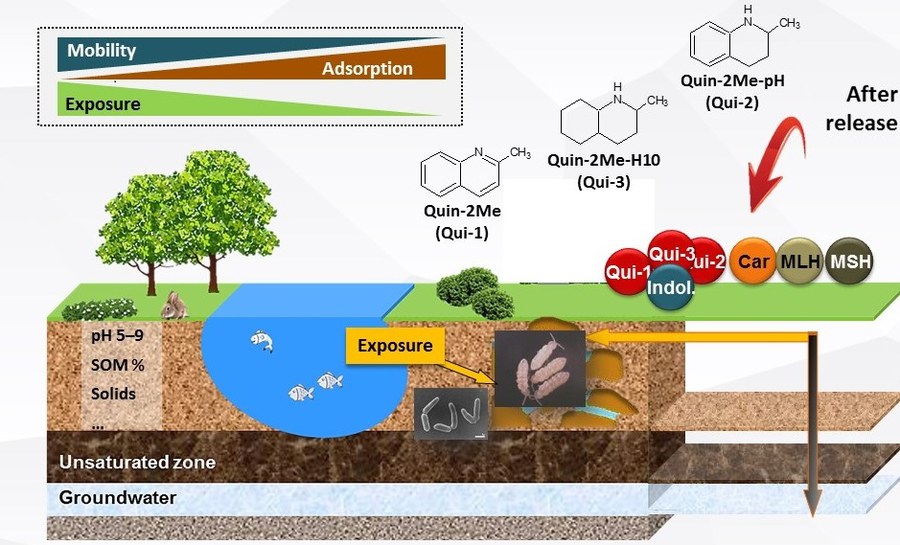
Liquid organic hydrogen carriers(LOHCs) are a potential alternative for safely storing renewable energy—such as wind and solar power—in the form of hydrogen in a way that ensures long-term stability. In this process, hydrogen is chemically bound to the carrier material through the hydrogenation of unsaturated bonds. Our pioneering work in this field of research has led to the first pilot-scale applications in recent years. A wide variety of chemicals can be used for this purpose. In collaboration with the Bavarian Hydrogen Center ( BHC) and the research group led by Prof. Dr. Peter Wasserscheid, we are searching for structures that not only offer an optimal technical performance profile but also pose the lowest possible risk to humans and the environment. To this end, we investigate, among other things, (eco-)toxicological profiles and biodegradability under various environmental conditions. When assessing potential hazards, we consider not only the pure substances used but also the complex mixtures of substances that arise during technical processes.
Would you like to learn more about how LOHCs work, and are you interested in the initial environmentally relevant research results?
Please read more about this in
Chu T., Su G., Chen Y., Zhang S., Stolte S., Markiewicz M. (2026) Avoiding the Next Chemical Legacy? Early Assessment for Liquid Organic Hydrogen Carrier Systems.
Environmental Science & Technology, 60, 15414–15417.
Seol Y., Markiewicz M., Schmalz V., Bei S., Martin C., Wasserscheid P., Stolte S. (2025) Oxygenated Liquid Organic Hydrogen Carrier (oxo-LOHC) systems: The biodegradation and endocrine-disrupting potential of oxo-LOHCs, intermediates, and transformation products. Journal of Hazardous Materials, 495 , 139030.
Seol Y., Markiewicz M., Bei S., Schubert S., Jungmann D., Wasserscheid P., Stolte S. (2024) Aquatic toxicity, bioaccumulation potential, and human estrogen/androgen activity of three oxo-Liquid Organic Hydrogen Carrier (oxo-LOHC) systems Journal of Hazardous Materials, 476 , 135102.
Zhang Y.-Q., Stolte S., Alptekin G., Rother A., Diedenhofen M., Filser J., Markiewicz M. (2020). Mobility and adsorption of liquid organic hydrogen carriers (LOHCs) in soils—an environmental hazard perspective. Green Chemistry, 22, 6519–6530.
Markiewicz M., Zhang Y.-Q., Empl M., Lykaki M., Thöming J., Steinberg P., and Stolte S. (2019) Hazard assessment of quinaldine-, alkylcarbazole-, benzene-, and toluene-based liquid organic hydrogen carrier (LOHCs) systems. Energy & Environmental Science, 12, 366–383.
Markiewicz M., Zhang Y.-Q., Empl M., Lykaki M., Thöming J., Steinberg P., and Stolte S. (2018) Hazard assessment of quinaldine-, alkylcarbazole-, benzene-, and toluene-based liquid organic hydrogen carrier (LOHC) systems. Energy & Environmental Science, 12, 366–383 .
Zhang Y.-Q., Markiewicz M., Filser J., Stolte S. (2018) Toxicity of a Quinaldine-Based Liquid Organic Hydrogen Carrier (LOHC) System to Soil Organisms Arthrobacter globiformis and Folsomia candida. Environmental Science & Technology, 52, 258–265.
Markiewicz M., Zhang Y.Q., Bösmann A., Brückner N., Thöming J., Wasserscheid P., Stolte S. (2015) Environmental and Health Impact Assessment of Liquid Organic Hydrogen Carrier (LOHC) Systems—Challenges and Preliminary Results. *Energy & Environmental Science*, 8, 1035–1045. Open Access
Contact: Prof. Stefan Stolte