Study Diplom in Industrial Engineering and Management


© shutterstock_freedomz


© PantherMedia / Artinun Prekmoung


© shutterstock_PopTika


© AdobeStock_ nateejindakum
© PantherMedia / ake1150sb


© PantherMedia / pressmaster
Table of contents
Program Content
The Industrial Engineering and Management degree program is distinguished by its interdisciplinary focus. You will acquire broad knowledge in economics and engineering, as well as methods that will enable you to understand interrelated technical and economic issues and solve problems at the intersection of business, natural sciences, and technology. At the same time, you’ll have the opportunity to specialize in areas aligned with your individual interests in a way that’s second to none.
Quick Facts (Overview)
| Degree | Diploma (Dipl.-Wi.-Ing.) |
|---|---|
| Standard Duration of Study | Full-time: 10 semesters (5 years), Part-time: up to 20 semesters (10 years) |
| Language of Instruction | German (some elective modules are taught in English) |
| Start of Studies | Winter semester |
| Application period |
June 1 – July 15 via the application portal |
| Costs per semester |
Semester tuition, plus second-degree and long-term study fees if applicable |
Program Structure
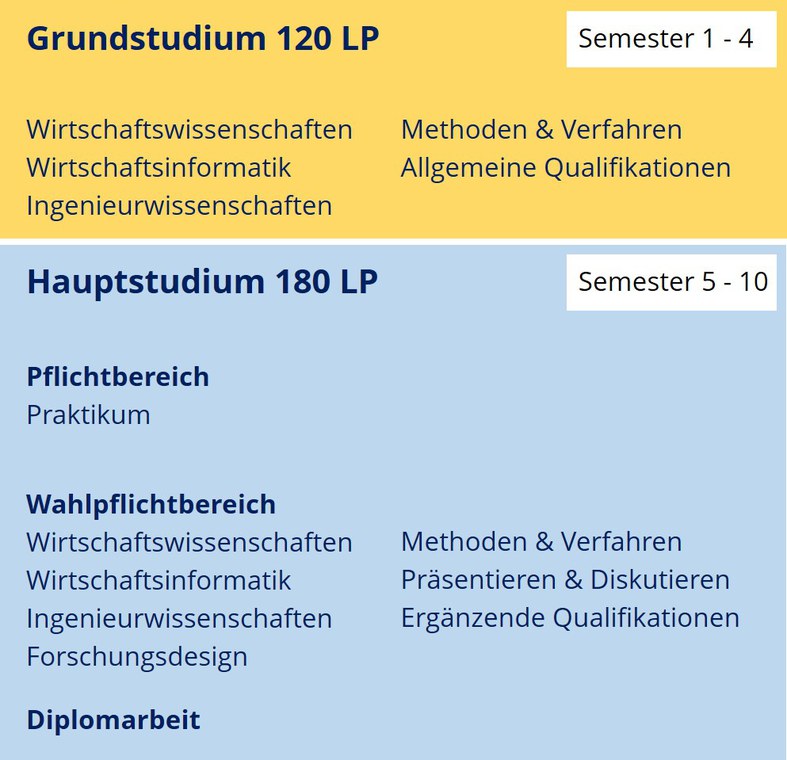
A total of 300 credit points are awarded in the Industrial Engineering and Management diploma program. The standard duration of study is therefore 10 semesters as a full-time student, although a flexible part-time study option is also available. Please visit our Part-Time Study webpage for more information.
In general, the degree program is structured as follows
Grundstruktur Diplom WiIng
- the introductory phase, which provides you with the substantive and methodological foundations in the various disciplines of the degree program, and
- the advanced study phase, which builds on this foundation and features a very broad range of required electives and the diploma thesis.
Foundation Phase
The introductory phase lasts 4 academic semesters and comprises 120 credit points. Here, you will acquire fundamental knowledge in
- Business Administration and Economics,
- Business Information Systems,
- engineering,
- methods and procedures, and
- general skills.
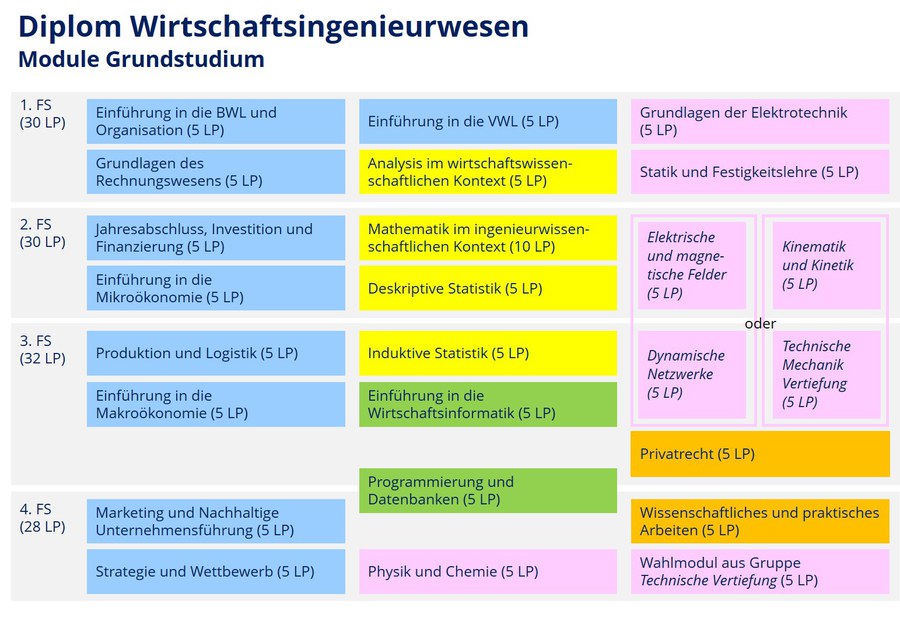
You can learn more about each of these areas and their content by clicking on the respective links. This semester plan shows exactly how the modules are distributed across the first semesters of the program—with modules in Business Administration and Economics in light blue, Business Information Systems in green, engineering sciences in pink, methods and procedures in yellow, and general qualifications in orange.
Semesterplan Grundstudium Diplom WiIng
Advanced Studies
The advanced studies program, comprising 180 credit points, is structured over 6 semesters. With an interdisciplinary focus, it offers a broad and in-depth education in economics, engineering, and more.

Grundstruktur Hauptstudium Diplom WiIng
Admission to the advanced studies phase is possible even without completing the introductory studies phase. However, you must have passed its core required modules .
Required Courses

The required component of the advanced studies phase (5 credit points) consists solely of the mandatory professional internship. It ensures that you apply the theoretical knowledge you have acquired during your studies to professional practice.
Elective-Compulsory Area
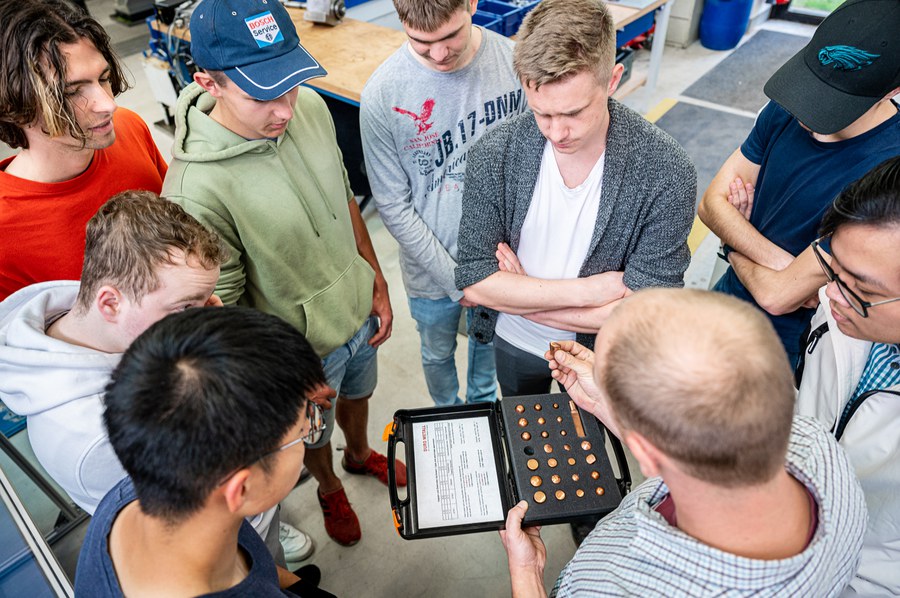
© Crispin-Iven Mokry


© Amac Garbe
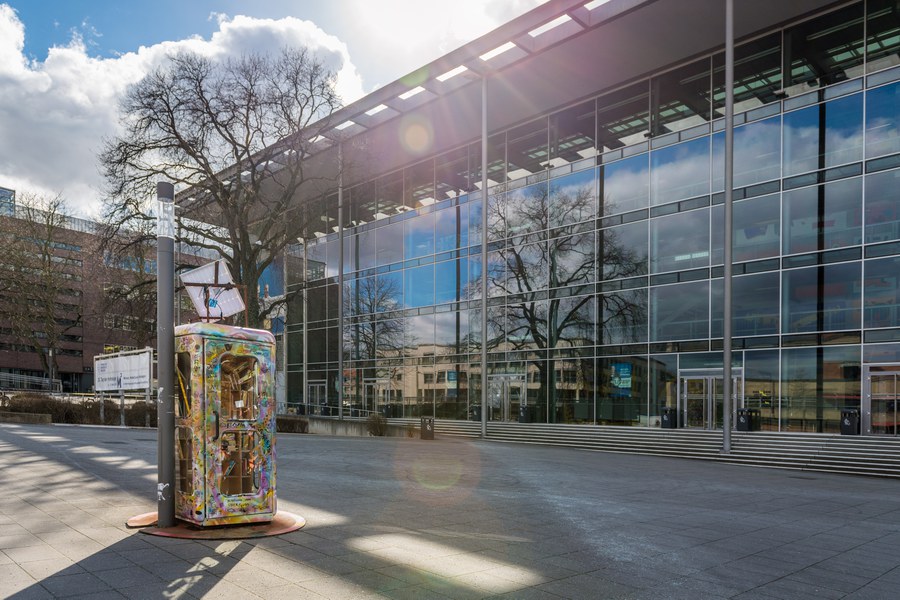
© Crispin-Iven Mokry
With 155 credit points, the required-elective component comprises nearly the entire main phase of study. Its structure offers you almost unlimited opportunities to tailor your studies entirely to your interests. You can find out which modules and profiles are available and how to select them on the Required-Elective Component webpage.
Courses/Timetable
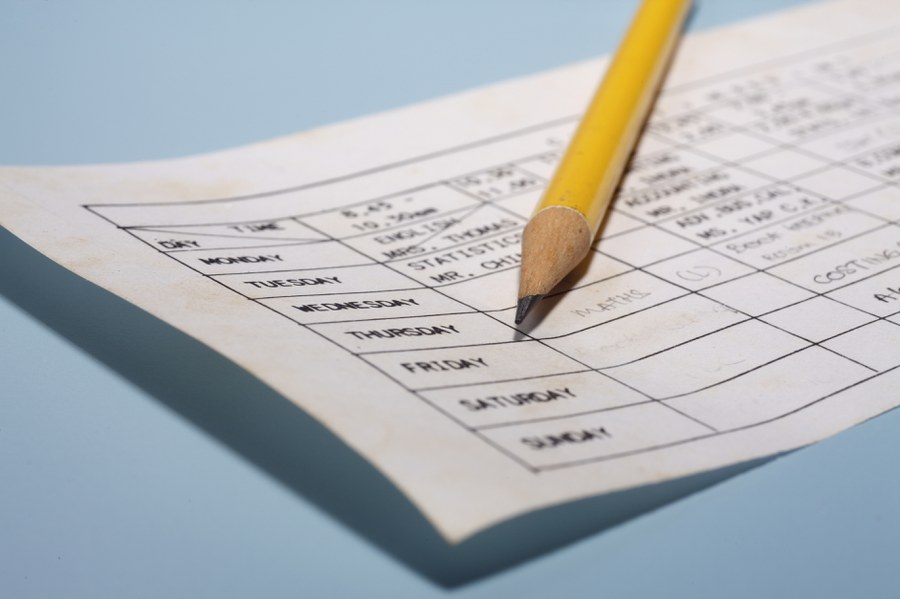
You can access an overview of the courses for the current semester and the class schedule via our Class Schedule webpage.
Academic Documents

You can find the current versions of academic documents (academic, examination, and other regulations) here.
You can also find these documents in the form of official announcements on the websites of the Office of Academic Affairs for Civil Engineering and Environmental Studies.
Thesis

© Crispin-Iven Mokry
© PantherMedia / matej kastelic
© Klaus Gigga
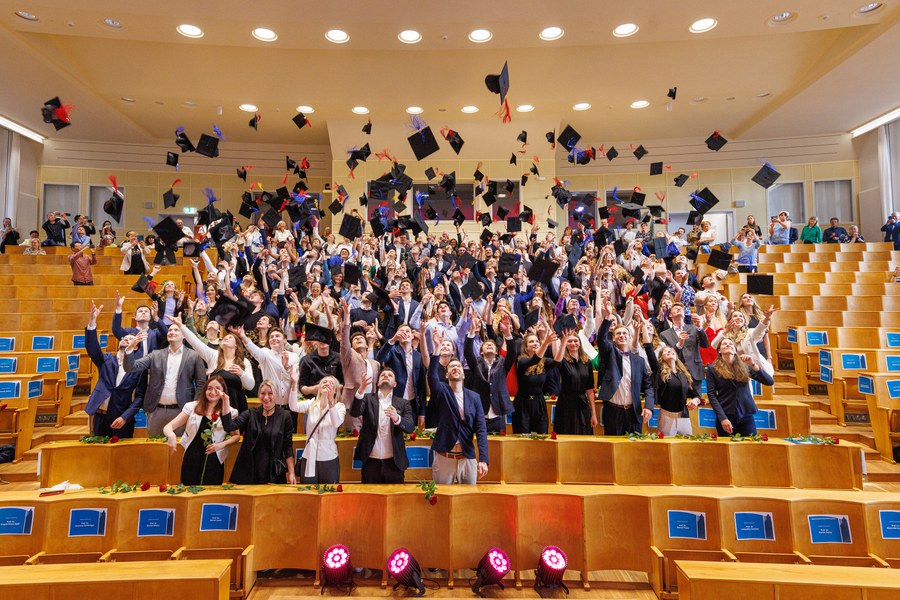
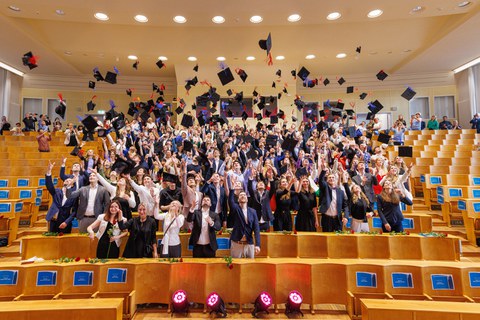
In your thesis, you will independently and scientifically address a research question in the field of Industrial Engineering and Management. You will have 16 weeks to complete it and will earn 20 credit points. The thesis typically marks the completion of your degree program.
Support is provided by the modules in the Research Design track. There, you will learn about research methods and present interim results.
Prerequisites: You must have passed all modules in the basic studies phase and earned at least 120 credit points in the advanced studies phase, including at least 5 from “Presenting and Discussing.” You must begin your thesis no later than the semester following your last module exam.
Important: Topic assignment, registration, and formal requirements vary by Chair. Therefore, please check the respective Chair websites for details.
Study Abroad

Want to study abroad for a semester or longer? The faculty offers you numerous opportunities—with over 60 Erasmus partner universities and additional partnerships worldwide.
The International Office supports you from the initial idea all the way through your return to Germany. Thanks to the flexible elective requirement, credits earned abroad can be easily transferred. Financial support is provided by programs such as PROMOS and the Prof. Endriss Prize, among others .
You can find more information here.
Career Prospects
Industrial engineers combine engineering and business and are therefore in high demand across many sectors, from manufacturing and trade to consumer goods and services. They often work at the intersection of these fields—for example, in production, logistics, product management, sales, or controlling—and have excellent prospects for leadership positions. Which industry is the best fit also depends on your specialization in engineering. With excellent academic performance, you can also pursue a Ph.D. and enter academia.
Our videos featuring graduates, available further down on this page, provide insights into real-world career paths.
Why TU Dresden?
It’s simple—this degree program has several advantages over other institutions:
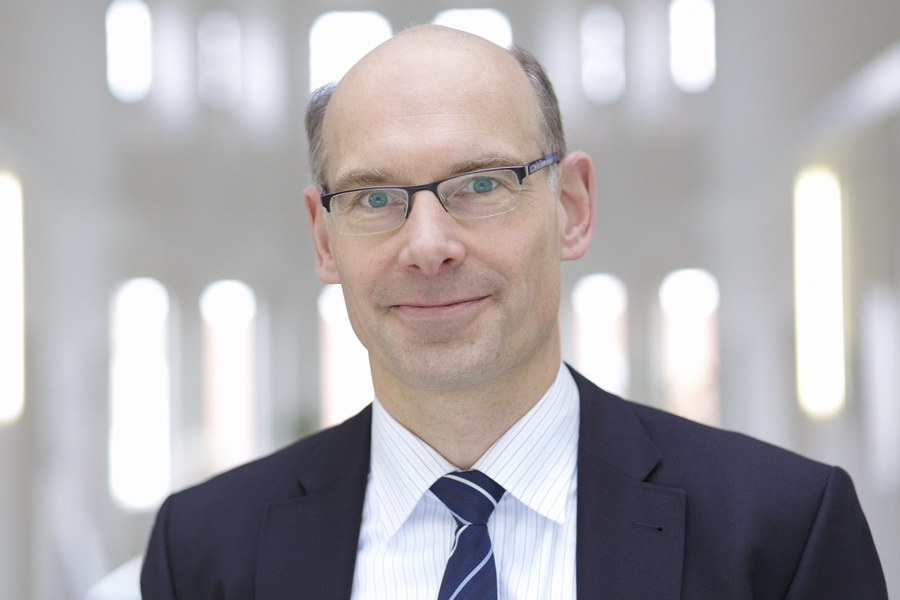
Prof. Dr. Udo Buscher, Studiendekan Wirtschaftsingenieurwesen: "An der Schnittstelle von Technik und Wirtschaft zeichnet sich der Diplomstudiengang Wirtschaftsingenieurwesen durch Interdisziplinarität und Vielseitigkeit aus. Aufgrund der großen Wahlmöglichkeiten mit individueller Schwerpunktsetzung können persönliche Interessen optimal umgesetzt werden."
- With the Diplom, you’ll earn a degree that’s recognized worldwide, giving you an edge over competitors with a master’s degree when you start your career.
- You’ll study without the interruptions that are common when transitioning from a bachelor’s to a master’s program.
- The required elective track offers immense opportunities to develop your individual profile. The six-semester core curriculum and the broader range of required electives provide better opportunities for specialization than a four-semester master’s program.
- You can choose from a total of 18 specializations in engineering. No other technical university in Germany offers this breadth of choice.
- Internships and study abroad experiences can be more easily integrated into the course of study.
- Consistent top rankings in university rankings (CHE, Wirtschaftswoche) attest to the degree program’s great popularity among students and companies.
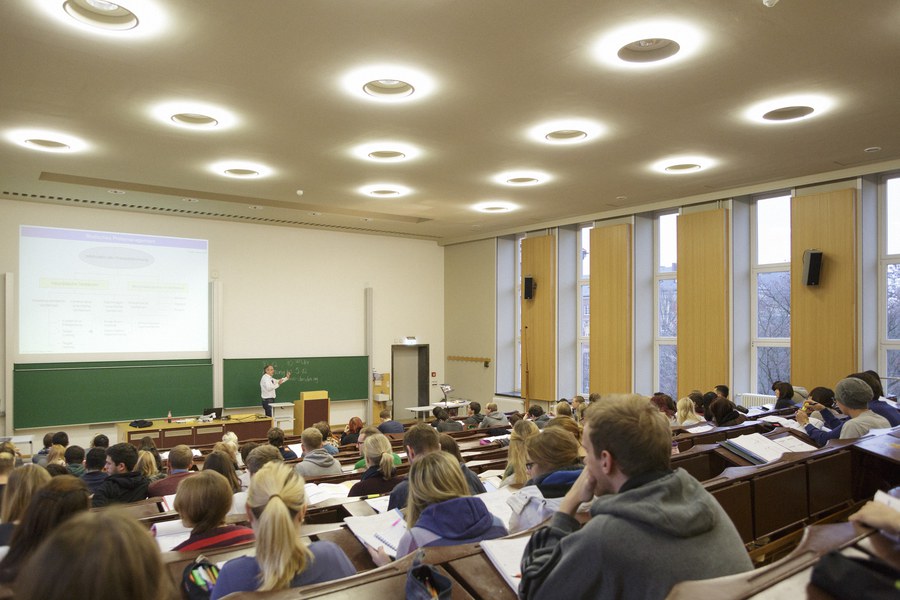
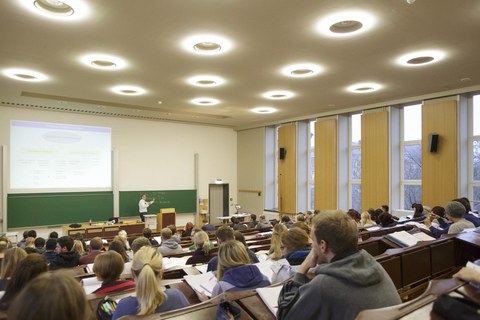
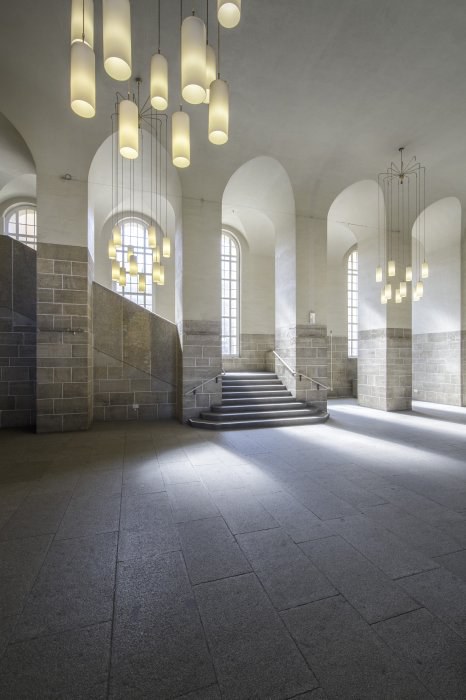
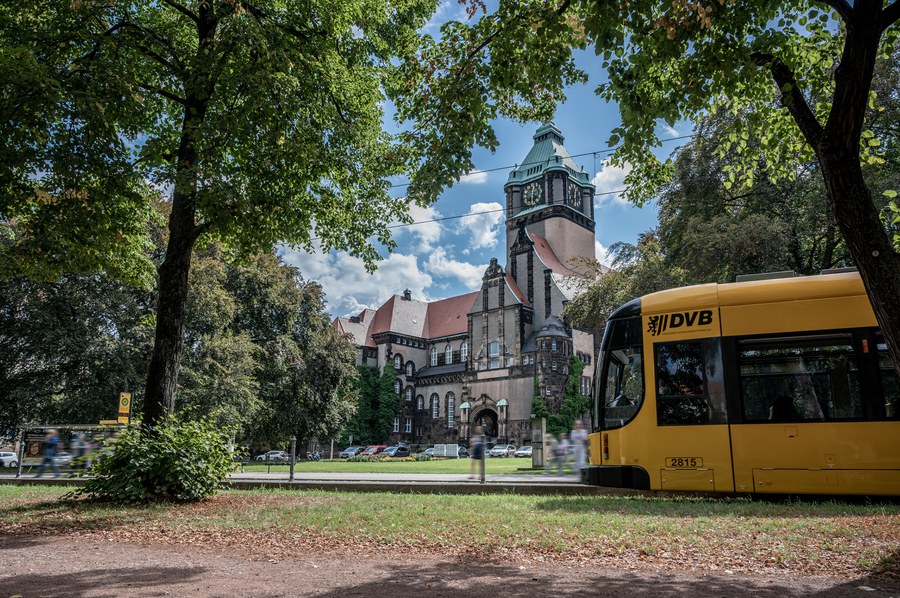
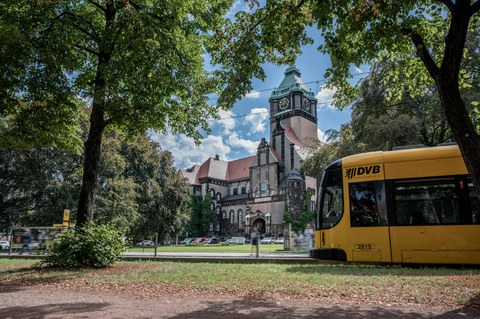
- Studying on Campus: Your studies will take place centrally on the main campus of TU Dresden in the Südvorstadt district. The chairs, the Dean's Office, and the Academic Affairs Office are located in the historic Georg-Schumann Building and the adjacent Hülße Building. Many courses are also held here. The engineering chairs, classrooms, and laboratories are all within walking distance. All facilities are easily accessible by public transportation or bicycle.
© Klaus Gigga
© Klaus Gigga
© Crispin-Iven Mokry
What Students and Graduates Say
In the following videos, students and graduates of the Industrial Engineering and Management diploma program talk about their academic and professional paths.
A quick note before we begin: All of these individuals studied the Diplom in Industrial Engineering and Management as it was offered prior to the 2024–25 winter semester. At that time, some course titles were different, and a few of the courses mentioned no longer exist. Nevertheless, their statements still provide a good impression of what studying is like today!
© Fakultät Wirtschaftswissenschaften
André and Lukas Brendler, students in the Industrial Engineering and Management diploma program
© Fakultät Wirtschaftswissenschaften
Tony Alexander, graduate of Industrial Engineering and Management, now working at Siemens AG
© Faculty of Business and Economics
Philipp Hauser, graduate in Industrial Engineering and Management and former doctoral student, now working at VNG AG
Contact and Advising
Academic Advising
Do you have any questions about the program or the application process? Our academic advisors will be happy to help you.
 © Paul Päprer
Paul Päprer
Academic Advisor / Basic Studies
Send encrypted email via the SecureMail portal (for TUD external users only).
 © Daniel Zähringer
Daniel Zähringer
Academic Advisor / Basic Studies
Send encrypted email via the SecureMail portal (for TUD external users only).
 © Sven Ellger / TUD
Dipl.-Wi.-Ing. Alexander Bade
Academic Advisor / Main Course of Study
Send encrypted email via the SecureMail portal (for TUD external users only).
Program Coordination
Have any suggestions or ideas for improvement? Please feel free to contact your program coordinators.

 © Udo Buscher
Prof. Dr. Udo Buscher
Diplom IEM - Studies Coordinator (Academic)
Send encrypted email via the SecureMail portal (for TUD external users only).
We’ve compiled additionaladvice and support services on our“Advising and Services” webpage.
More Insights & Stories on Social Media
On YouTube, Instagram, and LinkedIn, you’ll find even more glimpses into campus life, information on current research topics, and interesting events at the faculty. See you there.