
Elective Area


© Crispin-Iven Mokry


© Klaus Gigga


© Klaus Gigga
Table of contents
With 100 credit points, the elective component of the Master’s in Business Administration covers virtually the entire program and thus offers excellent opportunities for in-depth study and specialization.
Basic Structure
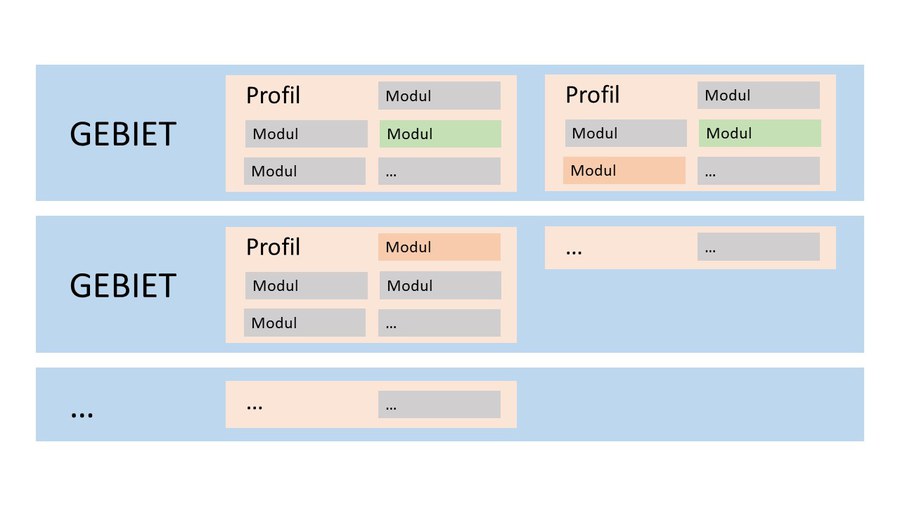
Grundstruktur Wahlpflichtbereich
- The modules in the required-elective section are assigned to subject areas and profiles.
- These fields form the flexible foundation of the required-elective component. Different flexible credit limits apply to them.
- The profiles within the subject areas allow you to further tailor the focus of your studies.
Modules
You can find the complete list of elective-required modules in the “Modules in the Elective-Required Area” table on the Study Documents website.
There you can also see which areas and profiles each module belongs to. Some modules are included in multiple areas and/or profiles at the same time due to the applicability of their content—see the modules highlighted in green or red in the diagram of the basic structure. These modules are primarily assigned to the profile that is thematically closest to them and secondarily to one or more additional profiles.
You can find out which content and learning objectives, teaching methods, and assessment requirements the modules include in the Module Handbook (Appendix 1 SO) on the “Study Documents” website.
Areas
The Master’s in Business Administration consists of five areas : Business Administration, Methods and Procedures, Presenting and Discussing, Research Design, and Supplementary Qualifications.
These areas cover the various learning objectives of your degree program and are designed to give you a high degree of freedom in your course selection. Thus, the credit points required in each area are not strictly prescribed.
When selecting modules, you need only observe the following flexible minimum credit requirements:
- 50 credit points in the area of Business Administration,
- 10 credit points in the area of Methods and Procedures,
- 5 credit points in the area of Presentation and Discussion,
- 10 credit points in the area of Research Design, which you take in conjunction with your master’s thesis.
You are free to choose the remaining 25 credit points in the required-elective area from these fields or from the supplementary qualifications. This flexibility makes it easy for you to tailor your coursework to your interests.
Profiles
Groups of modules that are thematically well-matched and complement each other form profiles. These profiles allow you to further refine and clarify the focus of your studies.


© shutterstock_freedomz


© shutterstock_PopTika


© Alberto Masnovo_shutterstock


© AdobeStock: adrian_ilie825


© nateejindakum_adobestock


© PantherMedia / pressmaster
The following profiles are available in the Master’s program in Business Administration:
Business Administration
- Accounting and Finance,
- Learning and Human Resources Management,
- Management and Marketing,
- Operations and Logistics Management,
- Sustainability Management and Energy Economics.


© shutterstock_Gaudilab


© PantherMedia / minervastock


© PantherMedia / Khunkorn Laowisit
Methods and Procedures


© PantherMedia / everythingposs


© Shutterstock_ABCDstock


© PantherMedia / Antonio Guillen Fernández
Additional Qualifications
- Public and International Economics,
- Business Information Systems,
-
Business Education and Management Training,
- Healthcare Economics,
- TransportEconomics.
Choosing a Specialization
There is absolutely no obligation to choose a profile! Instead, you simply decide which modules to take in the elective-required area, in accordance with the minimum credit requirements for each field. Once you have completed a sufficient number of modules belonging to a profile, you can have them recognized as a major or minor:
- A major requires modules from the profile totaling at least 30 credit points, of which at least 20 credit points must come from primarily assigned modules.
- For a minor, modules from the profile totaling at least 20 credit points are required, with at least 15 credit points from modules primarily assigned to that profile.
You can therefore earn multiple majors and/or minors—or choose not to pursue any at all.
For modules assigned to multiple profiles, you decide which profile the module will ultimately count toward. The module then counts toward the field to which the selected profile belongs.