
Sep 23, 2026
Two Research Papers presented at EGOV 2026
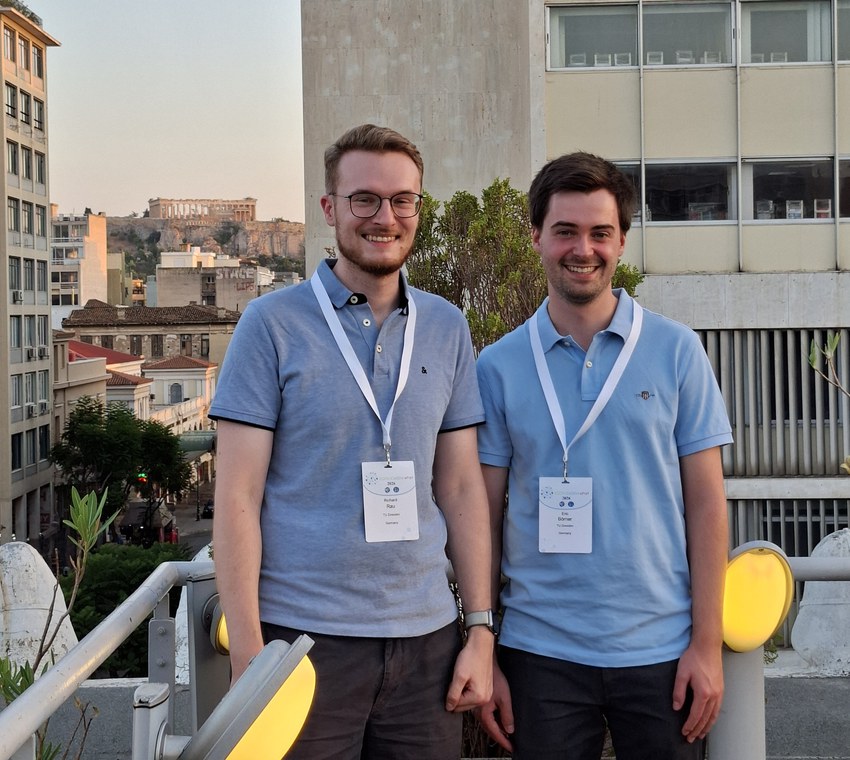
From August 30 to September 3, 2026, Eric Börner (Chair of Business Information Systems, esp. Information Systems in Industry and Trade) and Richard Rau (Chair of Business Information Systems, esp. Business Engineering) attended the 25th IFIP WG 8.5 International Conference on Electronic Government (EGOV 2026) in Athens. The international conference brings together researchers from the fields of electronic government, open government data, smart cities, as well as digitalization and artificial intelligence in the public sector. In this context, two research papers from the two chairs were presented and discussed with the international academic audience.

Eric Börner presented the paper “The Social Dynamics of OGD-Based Application Development: A Case Study on Motivation and Networking”. The study examines the role of motivation and networking among independent developers in the long-term development of applications based on Open Government Data (OGD). Using two mobile OGD-based applications that have been in operation for more than ten years, the study examines how motivational factors and networks among independent developers of OGD-based applications change over time.

Richard Rau presented the paper “Citizens’ Intention to (Re)Use Open Government Data: The Perspectives of Non-users and Users and the Moderating Role of Use Purposes”, co-authored with Martin Wiener and Katja Bley. The study examines which factors influence citizens’ intention to use or reuse open government data. Based on a survey of 621 respondents, the authors distinguish between existing users and individuals with no prior experience using OGD. The results reveal differences between the two groups: While expected utility and data literacy are particularly relevant for existing users’ continued use, factors such as awareness of OGD and its contribution to transparency play an important role for non-users.
Participation in EGOV 2026 provided an opportunity to present the latest research findings to international academic audiences and to gain new insights for further research in the field of Open Government Data and digital government.
The research was conducted as part of the Smart Cities Model Project (MPSC) and was funded by the City of Dresden, the German Federal Ministry for Housing, Urban Development and Building (BMWSB), and KfW.
