
Diversity Days 2026
Diversity Days 2026 – What We Don’t See: Invisible Realities on Campus
This year’s Diversity Days will take place at TUD Dresden University of Technology from November 2 to 6, 2026. Under the theme “What We Don’t See: Invisible Realities on Campus,” the event will spotlight issues that often remain hidden yet shape the daily lives of many people at the university.
Whether it’s invisible disabilities, chronic illnesses, caregiving responsibilities, psychological abuse, financial insecurity, or discrimination —the range of invisible realities is vast. The goal of Diversity Days is to make these issues more understandable, create space for dialogue, and foster understanding.
Program:
Monday, November 2
- Getting Started & Raising Awareness
- Why Menopause Is Also an Economic Issue
- Understanding: What Happens During Menopause?
- Statistics That Make a Difference
- Leadership That Makes a Difference: Rethinking the Workplace
- Health Services & Benefits
- From Issue to Culture
This informational session offers fascinating insights into the MHFA (Mental Health First Aid) concept, the support provided by mental health first aiders, and the structure of the training program. We look forward to exchanging ideas with you!
in German
Registration: https://www.dhsz.tu-dresden.de/angebote/aktueller_zeitraum/_Erste_Hilfe_fuer_psychische_Gesundheit_an_der_TUD.html
Amid lectures, meetings, projects, and the stresses of everyday life, short breaks often get neglected. The Mindful Break offers a brief respite to recharge and consciously find peace. Through elements of light movement, mindful body awareness, and short meditations, it demonstrates how mindfulness can be easily integrated into your daily work or study routine.
In German
Registration link: https://www.dhsz.tu-dresden.de/angebote/aktueller_zeitraum/_Achtsame_Pause_-_Ein_Moment_zum_Innehalten.html
this activity invites participants to make their own stickers representing invisible realities. As the geographer Hannah Awcock writes, stickers can express solidarity or a desire for change, declare the existence of an individual or group, and construct and maintain a collective identity. No artistic skill is needed: as a media form, stickers are good because they can be bad. Some materials and the sticker-maker will be provided, but feel welcome to bring your own pens and anything you feel should help to make a sticker.
What is your reality on campus, how’s student life treating you in Dresden? Together, we would like to gather all your experiences – the good ones, the hidden ones, and the missing ones. This way, the institutions for the Internationals on campus get the chance to see with your eyes, to learn about your ideas, and to develop opportunities to change your reality on campus.
Location: FOE 101
Film with an introduction
Ángela is deaf, Héctor is hearing—a young couple, happy and in love, all the more so now that they’re expecting their first child. They’ve decided to name her Ona, a girl. But the closer the day of her birth gets, the more anxious Ángela becomes. How will she care for Ona in a world that isn’t made for her? Will Ona hear like Héctor or be like her? The small, sheltered world that Ángela and Héctor have created for themselves begins to crack. They must try again—in the world as it is and as it could be.
With sensitivity and honesty, tenderness, and always on equal footing with her protagonists, writer and director Eva Libertad tells the story of the unexpected challenge of having a child as a deaf woman in a world full of barriers—of encounters and misunderstandings, respect and diversity, of love and trials of endurance.
Location: Zentralkino
Free admission
Tuesday, November 3
Qualification and a career in academia are exciting, but also challenging. Publication pressure, heavy workloads, and the constant juggling of work and personal life can lead to overload – sometimes at the expense of mental well-being.
In this workshop for postdocs , you will have the opportunity to pause, share experiences, and learn practical strategies. We will explore questions such as:
- How can I manage stress in my academic daily life?
- How can I actively shape my work-life balance?
- Which small steps can help me stay healthy and productive in the long term?
In addition to reflection and exchange, the workshop offers concrete, practical impulses that can be applied directly in your everyday life. It is led by a psychotherapist with extensive experience in both clinical and preventive contexts – and who is also available to answer any questions you may have.
This workshop is offered in cooperation with the Techniker Krankenkasse (TK)
Speaker: Linda van den Berg
The number of participants is limited. Register here: https://promovendus.tu-dresden.de/course_description?0&number=1208
An oral exam, speaking up spontaneously in class, the third group project this week… and somehow it seems like nobody else even cares?
Welcome to the club.
This workshop focuses on the challenges introverted students face in an often very extroverted college environment: loneliness despite packed lecture halls, energy drain from group work, fear of blanking out during oral exams, and the nagging question of whether there’s something “wrong” with you. Together, we’ll examine these situations, understand the psychological reasons behind them, and gather practical tips for when you’re in the thick of it.
By the end, you’ll not only walk away with strategies that make it easier to navigate an environment full of extroverts, but also with a new perspective on the strengths that we introverts can leverage.
And don’t worry: You won’t have to speak in front of the group, and there won’t be any icebreaker group introductions—I promise! The workshop is designed so that we can all feel comfortable.
Reading and discussion with Ukrainian author Iryna Fingerova about her novel *Zugwind* and identity in times of uncertainty
How does one carry on when war dominates everyday life? Where does one find the strength to feel joy when fear, loss, and uncertainty shape one’s existence? These questions are at the heart of the reading and the subsequent discussion with author, physician, and journalist Iryna Fingerova.
Drawing on her latest novel and her personal experiences, Fingerova explores the apparent contradiction of hedonism in times of war. What is considered a luxury or pleasure under normal circumstances becomes a form of survival during wartime. Joy, humor, music, dance, and human connection become acts of resilience and resistance against the destruction of everyday life.
Odesa plays a special role in this—a city whose identity is shaped by cultural diversity, self-deprecating humor, and a zest for life. Even in times of greatest threat, its residents retain their sense of humor and their will to celebrate life. This attitude forms the starting point for an exploration of identity, memory, and belonging.
In the novel, the audience follows a Ukrainian family doctor in Germany whose life is shaken by the war in her homeland. Amid her work with refugees, family obligations, and her longing for Odessa, she searches for comfort, meaning, and a sense of home. The literary narrative weaves together personal experiences with universal questions about migration, responsibility, and humanity.
The reading will be followed by a moderated discussion. Together, we will explore how identity emerges in times of fragility, the role that literature and art play in coming to terms with crises, and why a zest for life can be a form of hope and resistance even under extreme conditions. The event creates a space for encounter, reflection, and German-Ukrainian dialogue.
Seating is limited. Registration is requested.
Location: FOE 402
Between feeling threatened and empowerment, discrimination and queer joy: Queer realities are diverse and still often invisible. In this workshop, we want to examine our privileges, listen to queer needs, and build alliances. For queers, allies, and those open to the topic."
Languages: German; English is available
Chronic illnesses and disabilities place an additional burden on affected students during their studies—a burden that is (mostly) not apparent to others, since chronic illnesses, in particular, are often invisible. This can lead to isolation, as it can create the feeling of being the only person facing this challenge. As part of the Faculty Student Council for General Education Schools (FSR ABS), we would therefore like to offer events organized by students for students.
In a presentation, we’ll provide information about the resources available at TUD. This presentation is intended for both students living with chronic illnesses or disabilities and their family members. Afterward, we’d like to provide an opportunity to network over snacks and board games, so everyone can get to know one another and share their experiences.
Solidarity is our greatest strength! So come on by, bring some friends, and let’s chat, eat, get to know each other, and paint on clothes or patches while we’re at it (we’ll provide the materials, but feel free to bring your own clothes)! The food is vegan and can be made gluten-free.
Wednesday, November 4
Many differences between people are not apparent at first glance. Chronic illnesses, neurodivergent information processing, mental health challenges, caregiving responsibilities, financial uncertainties, cultural influences, or individual experiences often shape daily life in school and at work without being immediately visible to others. At the same time, these hidden realities have a significant impact on how people collaborate, communicate, and overcome challenges.
In this 90-minute event hosted by the Center for Demography and Diversity (CDD), we will present scholarly findings from management research as well as industrial and organizational psychology that explain why invisible diversity characteristics present both opportunities and challenges for collaboration and a sense of belonging. The focus will be on the Categorization-Elaboration Model, social identity theory, and current research on psychological safety and inclusive leadership. Based on empirical findings, the event will demonstrate how invisible differences influence knowledge sharing, creativity, trust, and well-being within teams, and which framework conditions help ensure that diverse perspectives can be constructively incorporated.
The CDD’s academic insights are complemented by interactive workshop elements. Participants reflect on which visible and invisible characteristics shape their own identity, what assumptions we often make about others in everyday life, and how these can influence our collaboration. Using practical case studies, the discussion will focus on how psychological safety, inclusive leadership, and an appreciative organizational culture can help acknowledge different life realities and better leverage the potential of diverse perspectives.
Speaker: Prof. Dr. Stefan Razinskas
Advisor: Prof. Dr. Karim Fereidooni (Ruhr University Bochum)
In this lecture, Prof. Dr. Karim Fereidooni will discuss ways to unlearn racist knowledge and to build anti-racist competencies. The lecture centers on the question: What must individuals and institutions do to act in a way that is critical of racism or to initiate a process of organizational development that is critical of racism?
The lecture will take place online (Zoom). Please register for the lecture using this online form so that we can send you the access link in early November.
The lecture is part of the “Courage—Know, See, Act” continuing education series and is open to all interested parties.
FSR General Education Schools
Chronic illnesses and disabilities place an additional burden on affected students during their studies—a burden that is (mostly) not apparent to others, since chronic illnesses, in particular, are often invisible. This can lead to isolation, as it can create the feeling of being the only person facing this challenge. As part of the Faculty Student Council for General Education Schools (FSR ABS), we would therefore like to offer events organized by students for students.
This workshop is aimed at those affected.
University Group for Children of Working-Class Families
This discussion forum is aimed at first-generation students—anyone who is the first in their family to pursue a college degree. What is it like to be the first person in your family to go to college? What challenges, doubts, and successes shape this journey? And how can you confidently shape your own educational path? The focus is on sharing personal educational stories, discussing shared experiences, and reflecting on the role that social background plays in higher education. The forum offers the opportunity to meet people with similar educational backgrounds, encourage one another, learn from each other, and build a supportive network.
Reading and Discussion with Sibel Schick
Sibel Schick has experienced firsthand that abortions can save lives. But bodily autonomy is not a private matter—the reproductive body has become a political issue. The current debates surrounding surrogacy demonstrate this once again: The question of whether and under what conditions we want to have children is highly political.
Drawing on her own experiences, Sibel Schick powerfully analyzes the structural violence that operates wherever people are denied the right to make decisions about their own bodies. In a moving and combative way, she demonstrates that true justice lies in collective liberation.
Organizer: Chair of Applied Linguistics, TU Dresden
Moderator: Anne Sophie Neubert
Book table: Buch mit Handlung, Dresden-Pieschen
Location: riesa efau. Kultur Forum Dresden, in the Motorenhalle
Wachsbleichstraße 4a, 01067 Dresden
No registration required!
Thursday, November 5
Explore the diversity of backgrounds in a playful way, discover fascinating life stories, and create your own visions. The resulting works of art will become part of a shared “Gallery of Futures” and can also be taken home.
Location: HSZ 301
No registration required!
Friday, November 6
How does racism manifest itself in everyday life? What prejudices and stereotypes shape our view of other people, and what can photography reveal that often goes unnoticed in everyday life?
The digital opening brings together the two exhibitions “Life Without Racism 2.0” and “Under Suspicion.” Photographer Gerardo Palacios Borjas offers a personal insight into his work and takes participants on the journey that led him to his current work in anti-racist and development education.
Through selected photographs, images, and stories, participants will gain insight into both exhibitions. The works explore experiences of racism and discrimination, societal stereotypes, and structural inequality. The focus is consistently on the individual—with their experiences, their individuality, and their right to be perceived beyond stereotypes.
The photographs open up different perspectives and provide space for personal experiences and emotions. They encourage viewers to look more closely, to question their own perspectives, and to engage with the realities of life that are often overlooked in everyday society.
Especially in times of rising populism and entrenched prejudices, the digital opening aims to create a space for reflection, empathy, and open dialogue. Following the tour of the exhibitions, participants are invited to ask questions, share their thoughts, and engage in conversation with one another.
This exchange is based on respectful, objective communication, the protection of personal data, and the responsible handling of shared content. Advertising, as well as screenshots, recordings, and screen sharing, are permitted only with the express consent of the moderators.
Access to the digital space: https://tu-dresden.zoom-x.de/j/67638235426?pwd=FcICtSLYOpGwTKk1CUWf4OAuWEnIxx.1
No registration required!
Are you neurodivergent, or do you suspect you might be? Do traditional learning and work techniques tend to cause you frustration rather than provide relief? It doesn’t have to be that way!
In our workshop, we’ll provide you with tips and techniques tailored to you and your needs. In a safe and supportive environment, we’ll discuss common challenges and explore practical solutions to make your everyday university life easier.
Note: No diagnosis is required to participate in the workshop.
The learning and study techniques are primarily aimed at the following neurodivergent conditions:
- ADHD
- Autism
- Learning and specific learning disabilities (e.g., dyslexia, dyscalculia)
Of course, other forms of neurodiversity are also welcome! To help us better tailor the workshop to all participants, please send us a brief email describing your individual needs or typical challenges to
We will, of course, treat these emails confidentially and delete them immediately after the workshop.
Registration: https://bildungsportal.sachsen.de/opal/auth/RepositoryEntry/44587810816/CourseNode/1787020586603194006
Location: FOE 135
Art is a beautiful form of human expression, but it can also come off as slightly inaccessible and elitist. This crafternoon will function as a space to get creative no matter your experience level, to express yourself, and to simply have a good time!
After a brief presentation (10 mins) on the history and ethos of „outsider art“, we’ll try out creating collages expressing our stories, experiences and realities that often go unnoticed on campus. At the end of the afternoon, you can freely choose to take your collage home as your own personal keepsake, or to leave it with us to be scanned and added to our online exhibition (you will, in this case, naturally be able to collect your artwork at a later date).
Don’t be shy about joining in later or leaving earlier – we’re happy to have you with us for any amount of time.
There will be plenty of materials like fabrics, magazines, paper sheets etc. provided, but if you have some resources you’d like to use for your collage, feel free to bring it along! And if you don’t like sharing scissors or glue, you’re welcome to use your own there as well.
We will work in two accessible rooms: One open for community work and chatting, one for working in a quieter environment. If you have needs, concerns or questions regarding accessability, we encourage you to reach out to us!
Rooms: HSZ 208 (small room), HSZ 301 (large)
Saturday, November 7
Do you ever feel that, in certain situations, you aren’t taken seriously or are overlooked because of your age? How do you experience prejudices or stereotypes associated with your age?
Through the “Speaking & Listening” dialogue format, we’d like to create a space to explore these questions. In small-group discussions, you’ll have the opportunity to share your experiences and opinions while also learning about other perspectives. To ensure an equitable and respectful exchange, each person will be given the same amount of speaking time. We look forward to hearing your perspective.
Presented by the Directorate of University Culture, Unit University and Society
Admission is free; please register at https://tud.de/universitaetskultur/sprechen-zuhoeren.
Location: HY! Community Room at the German Hygiene Museum
Individual Needs
It is important to us that all participants feel comfortable during the Diversity Days and experience the framework conditions as supportive. In addition to accessible rooms, this also includes improving accessibility in a broader sense - with foresight and on an individual basis.
If you have individual needs in terms of mobility, ergonomics, vision, hearing, communication or family requirements, please do not hesitate to contact us. We want to make your participation in the format as pleasant as possible.
Contact
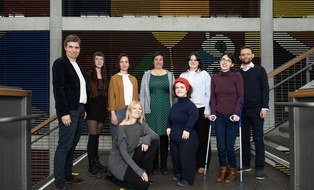 © Sven Ellger/TUD
Unit 9.3 Diversity Management
Send encrypted email via the SecureMail portal (for TUD external users only).
Visiting address:
Verwaltungsgebäude 3, 7-208 Nöthnitzer Str. 43
01187 Dresden
Postal address:
TUD Dresden University of Technology
Directorate 9 University culture
Unit 9.3 Diversity Management
01062 Dresden