
Sep 29, 2026
Congratulations to Julian Heinrich for his successful PhD defense
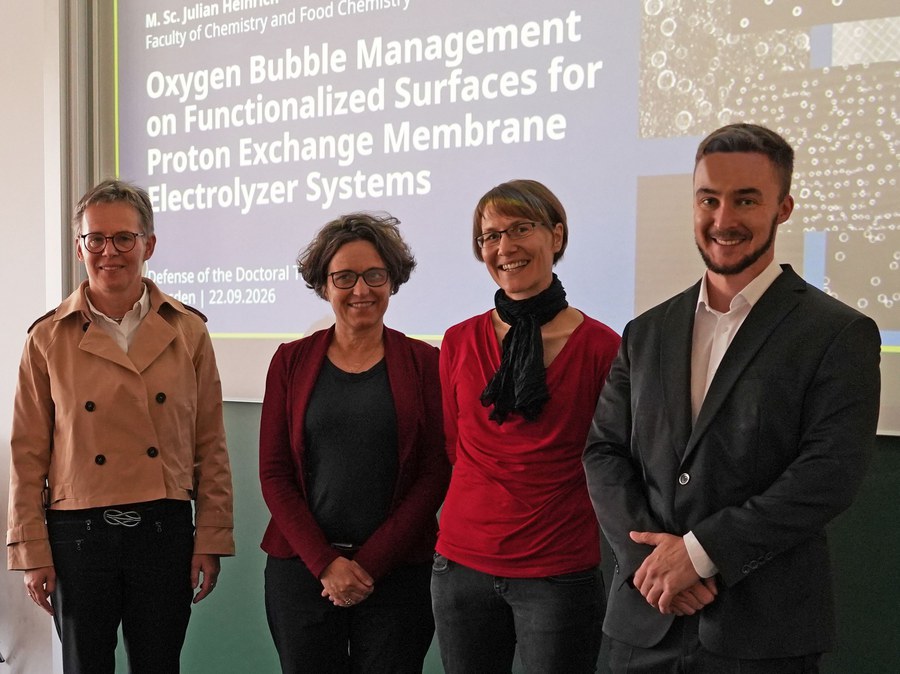
On 22 September 2026, Dr. rer. nat. Julian Heinrich successfully defended his dissertation entitled "Oxygen Bubble Management on Functionalized Surfaces for Proton Exchange Membrane Electrolyzer Systems".
This work addresses a critical challenge in sustainable hydrogen production: the efficient management of oxygen bubbles formed during the oxygen evolution reaction in proton-exchange membrane (PEM) electrolyzers. As renewable energy sources introduce power fluctuations, PEM electrolysis offers a dynamic solution to convert surplus electricity into green hydrogen. However, gas bubble accumulation reduces heat and mass transfer efficiency, what limits overall system performance.
Julian’s research explores how surface functionalization can be used to precisely control solid-gas interactions. Using plasma-enhanced chemical vapor deposition (PECVD), he modified high-roughness substrates, investigated for periphery components and produced via additive manufacturing, with tailored polymeric coatings to adjust wettability. Long-term stability studies revealed that these coatings effectively influence bubble nucleation and detachment even after 150 days, despite environmental aging.
Complementary experiments employed direct laser interference patterning (DLIP) to create microstructured, cross-like surface features on metallic substrates. These structures enhanced surface area and enabled reversible wettability changes, with hydrophobic surfaces promoting dense nucleation and hydrophilic surfaces facilitating bubble release.
A comparative analysis of conventional and additively manufactured substrates demonstrated that roughness significantly lowers the energy barrier for bubble nucleation, enabling earlier and more uniform gas formation. While PECVD offers stable, chemically tunable coatings, laser structuring provides superior surface area amplification and dynamic adaptability.
The results show that combining tailored surface chemistry and topography enables precise control over bubble behavior; enhancing nucleation, reducing surface coverage, and improving detachment. This paves the way for smarter, more efficient electrolyzer designs with reduced operational costs and higher durability.
Julian’s work bridges materials science, surface engineering, and electrochemical systems, offering practical strategies for advancing green hydrogen technologies in a carbon-neutral future.