
Oct 01, 2026
Retrieval-Augmented Generation as a Bridge Between AI, Biomedical Data, and Clinical Infrastructures
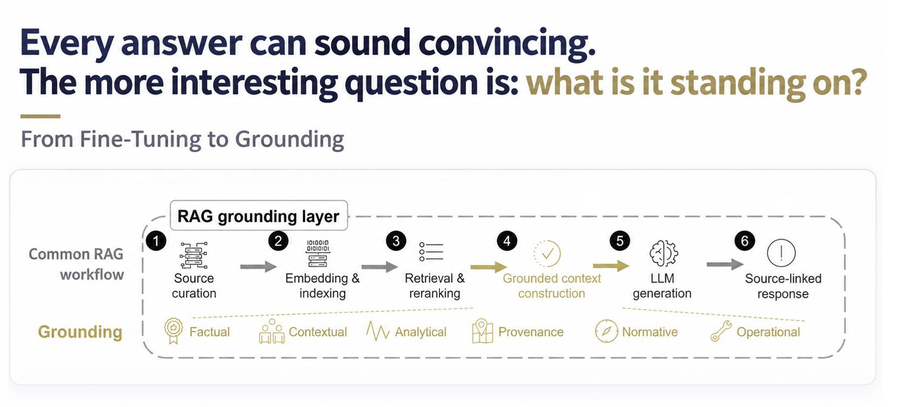
Schematic representation of a RAG grounding workflow: from source curation, retrieval, and context construction to a source-linked LLM response.
How can large language models be used in research and healthcare in a way that ensures their answers are not only plausible, but also grounded in transparent, up-to-date, and controlled data sources?
A simple example illustrates the challenge: A language model on its own does not “know” which version of a clinical guideline is currently valid, which laboratory value was measured at which point in time, or whether a specific cell marker is actually relevant in a particular tissue. Retrieval-Augmented Generation (RAG) addresses precisely this problem. Before generating an answer, relevant information is retrieved from suitable data and knowledge sources and provided to the model as additional context. A cell-type annotation can therefore be linked to current marker databases, for example, while a clinical summary can be grounded in specific findings, medical reports, and guidelines.
In the new publication “From Fine-Tuning to Grounding: Retrieval-Augmented Generation for Biomedical LLMs in Research and Clinical Data Infrastructures”, Mahdi Enayati, Vishnu Priya, Eveline Prochaska, Kathrin Sobe, and Markus Wolfien examine the potential of such approaches for biomedical research and clinical data infrastructures.
“For us, RAG is much more than a technical extension of a chatbot. It is about connecting generative AI with the data, knowledge, and rules that are actually relevant in research and healthcare,” says Markus Wolfien. “This is the core idea of a grounding infrastructure: answers should not merely be well formulated, but should be based on concrete sources, their context and provenance, and be used under the appropriate conditions.”
The work brings together perspectives from several research areas: data science and bioinformatics, interoperability and medical data integration, as well as artificial intelligence and large language models. This ranges from the analysis of complex omics and single-cell data to FHIR- and OMOP-based data structures and questions of evaluation, traceability, governance, and the safe integration of AI systems into existing infrastructures. The publication also reflects the close connection of these topics with ScaDS.AI Dresden/Leipzig.
Using two deliberately different application scenarios — single-cell and omics interpretation and the integration of electronic health records, PDF documents, and clinical free text — the authors show that biomedical RAG systems cannot be designed according to a single universal blueprint. In research settings, biological plausibility and access to current knowledge sources are particularly important, whereas clinical settings additionally require temporal context, provenance, access control, safety, and governance.
A central conceptual contribution of the publication is therefore the distinction between different forms of grounding. Beyond factual grounding in external knowledge, the framework also considers context, analytical results, provenance, normative requirements, and integration into concrete workflows. The key question is therefore not only whether an AI system produces a correct answer, but also what that answer is based on, in which context it is valid, and how it can be verified.
The publication highlights a broader development in the use of generative AI in medicine: future progress will not depend solely on the performance of individual models, but increasingly on how effectively AI, interoperable data infrastructures, domain-specific knowledge, and governance are connected.
Publication:
Enayati M, Priya V, Prochaska E, Sobe K, Wolfien M. From Fine-Tuning to Grounding: Retrieval-Augmented Generation for Biomedical LLMs in Research and Clinical Data Infrastructures. Sci. 2026;8(9):266. DOI: https://doi.org/10.3390/sci8090266