
Aug 28, 2026
Construction Future Lab (CFLab) in Görlitz: Research center for digital construction launches regular operations
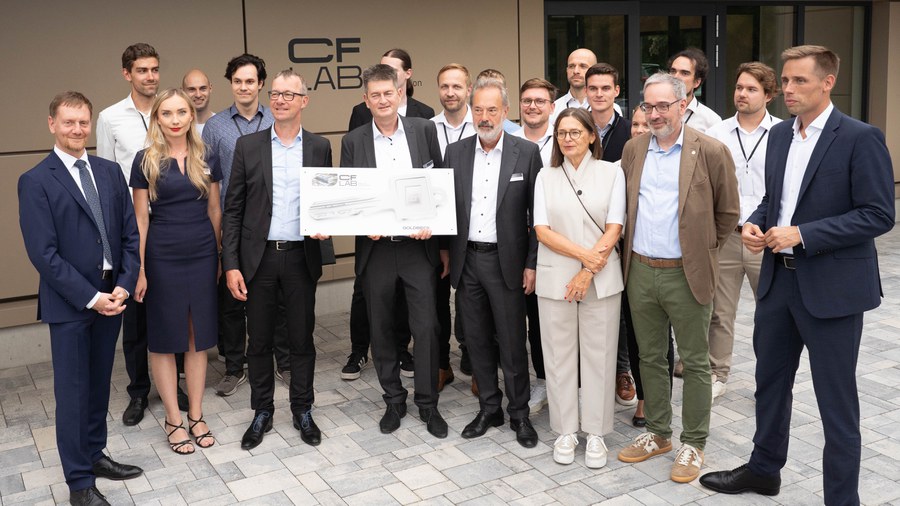
A symbolic key handover to the management of the CFLab. In attendance were, among others, Saxony’s Minister President Michael Kretschmer (left) and TUD Chancellor Jan Gerken (fourth from the right).
Digital construction sites, construction robotics, additive manufacturing, and 3D concrete printing: The Construction Future Lab (CFLab) unites innovative areas of application in digital technologies within a one-of-a-kind testing and research environment in Görlitz-Klingewalde. After approximately one year of construction, the keys were handed over today (August 28, 2026). In the presence of Saxony’s Minister President Michael Kretschmer, TUD Chancellor Jan Gerken, Görlitz Mayor Octavian Ursu, Member of the Bundestag Florian Oest, and other representatives from the worlds of science, research, business and politics, CFLab has officially entered its next phase of development and operations.
Construction Future Lab gGmbH is an independent, non-profit research institute, which was spun off from TUD Dresden University of Technology in 2022. The institute combines applied research and development in digital and automated construction. Their work focuses on innovation across all areas of the construction industry.
Minister President Michael Kretschmer emphasized the strategic importance of the project, “The Construction Future Lab in Görlitz demonstrates how innovation gives rise to genuine opportunities. In the lab, science and industry join forces to develop solutions for the construction of tomorrow: solutions that conserve resources, are climate-neutral, and economically viable. And this is exactly what we need. In Saxony, we want to do more than simply discuss the future of construction; we want to help shape it. This strengthens our position as a center for business and innovation, opens up new opportunities for Saxony’s construction industry, and creates added value and sustainable jobs in the Görlitz region. Construction Future Lab is a powerful example of how research can lead to growth and how innovation leads to excellent work prospects.”
Jan Gerken, Chancellor of TUD: “With Construction Future Lab, TUD | Campus Lausitz is gaining a research and technology transfer platform for the construction of the future. As a University of Excellence, we are also contributing our expertise in civil engineering, mechanical engineering, digitalization, and automation to network fields and processes that were previously separate, and to develop new technologies for automated construction. In collaboration with partners from research and industry, these are tested under real-world conditions and further developed into practical solutions. CFLab is a prime example of how to actively shape structural change in Lusatia through the close integration of cutting-edge research and technology transfer, and to provide new impetus for innovation, value creation, and skilled employment in the region.”
Digitalized construction: CFLab’s management looks ahead to a new chapter with a clear vision
Interdisciplinarity is at the heart of CFLab. This is also reflected in its management. Its three managing directors are Prof. Jürgen Weber (Chair of Fluidtronics at TUD), Prof. Frank Will (Chair of Construction Machinery at TUD), and Prof. Jens Otto (Chair of Construction Management at TUD).
Prof. Jens Otto sheds light on the construction management perspective: “Why are construction projects always getting more expensive and taking longer to complete? We have never really had a place to experiment with construction. And the prototype is often the product itself. Every mistake costs money. If you can't afford to fail, you become cautious and don't change anything. And that is exactly what we are changing here today. This building is the place where construction is allowed to fail. And this is only way we can ensure success in real-world operations.”
Prof. Frank Will looks at the construction machinery of the future: “Machines are now starting to perceive their surroundings. They can recognize danger and respond to them. But that doesn't mean people will disappear from construction sites. We're already facing a massive shortage of skilled workers. Instead, machines can perform dangerous tasks in addition to those that are monotonous for people. For this to be the case, they must be proven to be safe in all environments: in dirt, in rain, when they are working directly alongside people. Starting today, we will be conducting these rigorous security assessment here.”
Prof. Jürgen Weber focuses on the interaction between systems: “The individual components of machines are already outstanding. The problem lies much more in how they work on the construction site, where the products of many companies come together. Their devices, programs, and data don't communicate with each other. And no one simply opens up their systems just like that. It's an issue of trust. And we need a completely neutral ground for this. A building that does not belong to any manufacturer. And we now have this building in Görlitz.”
From vision to real-world infrastructure
With the handover of the keys to the new CFLab building in Görlitz, the development office, which already has a location in Dresden, is expanding. The combination of a research and demonstration hall, a digital laboratory construction site, and state-of-the-art equipment creates entirely new testing possibilities. "We use this infrastructure for the much-needed transfer of research findings into industrial products and processes. This is where solutions for the construction industry and construction machinery will be researched: through large-scale collaborative research projects, with a specific focus on practical applications, in partnership with small and medium-sized enterprises, and as part of research contracts from industry,” said André Sitte, CFO of CFLab.
A strong network for structural change
The existence of this testing site relies on the support of dependable partners. “We would like to express our sincere gratitude to the federal government and the state of Saxony. They support our personnel and infrastructure through the Coal Region Investment Act. A huge thank you to Goldbeck for the quick and professional construction work. We would also like to thank our Scientific and Technical Advisory Board for its strategic guidance, as well as all those who supported us in terms of organization and content,” says Prof. Weber.
The next steps involve renovations to the building, where construction robotics analyses are scheduled to be implemented starting summer 2027. In addition, the new facility for 3D concrete and clay printing will be built in the near future. The CFLab team is already planning its first major event on the grounds in spring 2027. In addition, as part of the project initiation phase, additional staff will be hired in Görlitz Klingewalde.
Background: CFLab
CFLab kicked off its activities as early as 2024 with an on-site information evening, which presented the project's objectives and the team behind the work. The start of construction was celebrated with a groundbreaking ceremony in August 2025. This marked the start of work on the research and demonstration center by the Goldbeck company. During this time, a team of 15 mechanical and civil engineers worked on various development projects in a joint office in Dresden. In addition, various machines, systems, and technologies have already been procured and will be transferred to Görlitz in the near future.
Contact
Benjamin Beck
Construction Future Lab gGmbH
Tel.: +49 152 25691262
Email: