
Oct 01, 2026
New Executive Board: TUD Rector Ursula M. Staudinger and Jan S. Hesthaven now lead the TU9 Alliance
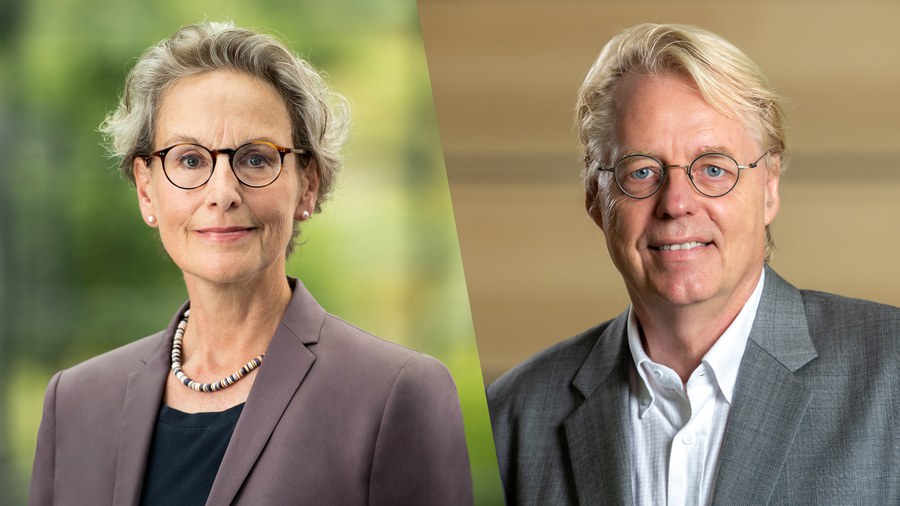
The new executive board of the TU9 Alliance of leading Universities of Technology in Germany: Prof. Ursula M. Staudinger und Prof. Jan S. Hesthaven.
As of October 1, 2026, the executive board of the TU9 Alliance of leading Universities of Technology in Germany changes. Prof. Ursula M. Staudinger, Rector of TUD Dresden University of Technology, is the new President. Prof. Jan S. Hesthaven, President of the Karlsruhe Institute of Technology (KIT), is the new Vice President. They take over from Prof. Angela Ittel, President of Technische Universität Braunschweig, and Prof. Peter Middendorf, Rector of the University of Stuttgart, who have jointly led the TU9 Alliance for the past two years.
“As TU9, we see it as our mission to ensure that Germany, in an AI-driven global economy, does not become a mere user of other nations’ systems. Building on the strength of German engineering, we must develop our own AI applications—so that Germany can once again claim leadership across a wide range of industrial fields. The TU9 Universities unite cutting-edge research with industrial practice: every third Excellence Cluster in Germany is hosted at a TU9 University, and one in four international students in Germany studies at a TU9 institution. To fulfill this role, however, we also need reliable economic conditions, streamlined administration, and powerful research infrastructure”, Prof. Ursula M. Staudinger says.
“The full potential of Germany’s research and innovation landscape is evident in the collaboration between (technical) universities, non-university research institutions, and industry. To secure Germany’s and Europe’s future as a technology hub, increased collaboration is essential. I am committed to strengthening these partnerships, particularly between universities of technology and non-university institutions. This is of great importance, especially regarding research security and security-related research,” Prof. Jan S. Hesthaven says.
Background information on the new TU9 Executive Board
Ursula M. Staudinger has been President of TUD, a University of Excellence, since 2020. Previously, she served as founding director of the Columbia Aging Center at Columbia University in New York, as vice president of Jacobs University Bremen from 2003 to 2013 and founding dean of the Jacobs Center on Lifelong Learning and Institutional Development. From 1985 to 1999, she conducted research at the Max Planck Institute for Human Development in Berlin. For her work in the interdisciplinary field of human aging, she was awarded the Braunschweig Research Prize and the Seneca Medal. She is a Fellow of the American Psychological Association (APA), the Association for Psychological Science (APS), and the Gerontological Society of America (GSA), and served as Vice President of the German National Academy of Sciences Leopoldina from 2007 to 2017.
Jan S. Hesthaven has been the President of the Karlsruhe Institute of Technology, a University of Excellence, since 2024. From 2021 to 2024, he served as provost and vice president for academic affairs at the École Polytechnique Fédérale de Lausanne (EPFL) in Switzerland, where he had been a professor of Mathematics since 2013. Prior to that, he was a faculty member at Brown University and founding director of the Center for Computation and Visualization (2006–2013), as well as a co-founder of the Institute for Computational and Experimental Research in Mathematics. Prof. Hesthaven is a Fellow of the Royal Danish Academy of Sciences and Letters, the American Mathematical Society, and the Society of Industrial and Applied Mathematics.
About TU9
TU9 is the Alliance of leading Universities of Technology in Germany: RWTH Aachen University, Technische Universität Berlin, Technische Universität Braunschweig, Technical University of Darmstadt, TUD Dresden University of Technology, Leibniz University Hannover, Karlsruhe Institute of Technology, Technical University of Munich, and University of Stuttgart. TU9 Universities take special responsibility for the productive and innovative strength of our society and economy. We help shape the future, for example by contributing to digitization and the energy and sustainability transition. To this end, we combine our specific expertise in basic research, especially in the natural sciences and engineering, with applied research and innovation. TU9 Universities enjoy an outstanding reputation around the world as renowned research and teaching institutions. As such, they train exceptional young academics for careers in science, business, and administration and assume social responsibility. TU9 Universities foster top-class international networks and diverse collaborations with industry, making them a key element of Germany as a science and innovation hub.