
Sep 14, 2026
Extensive renovations at the Botanical Garden: Temporary closure from September 21, 2026, through February 28, 2027
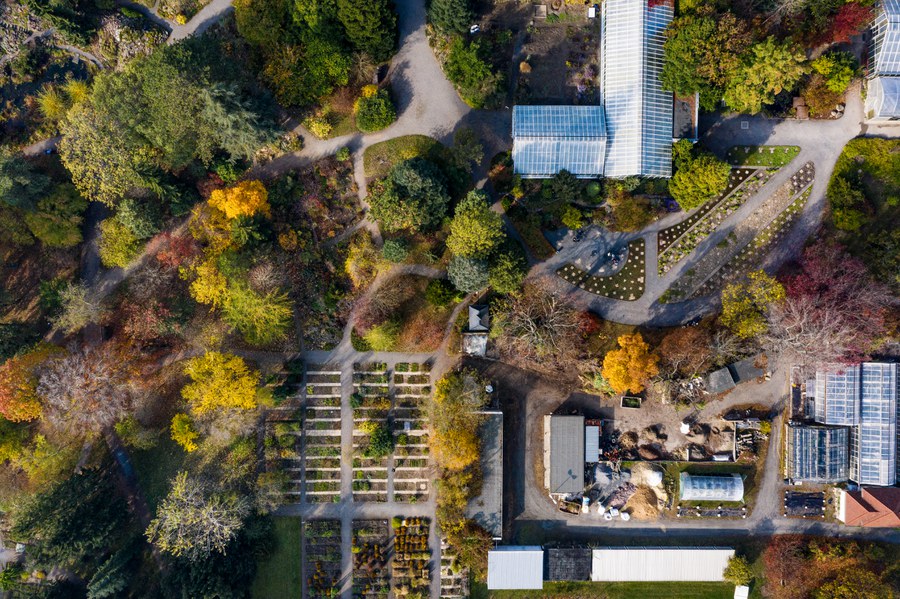
Aerial view of the Botanical Garden.
The Botanical Garden will be closed to the public from September 21, 2026, through February 28, 2027, to allow for construction work. The gardening team will also use this time to undertake repair and renovation work in the greenhouses and outdoor areas. Despite this closure, all educational events and guided tours scheduled during this period will take place as planned. Groups will be admitted on an individual basis. From March 1, 2027, until completion of construction in early 2029, the Botanical Garden will only be accessible to visitors via a temporary side entrance located on the east side of the Großer Garten Park.
Plans for redesigning the Botanical Garden at TUD Dresden University of Technology have been in the pipeline since 2022. The Geophyte House was completed in 2023 in the first construction phase, and is home to plants that survive unfavorable seasons underground.
This second construction phase will now include three additional projects in the area around the park entrance on Stübelallee:
- The former Inspector's House, located to the right of the entrance, which had only been provisionally rebuilt following damage during the war, will be renovated and expanded into a modern herbarium building. The building will house scientific plant collections—herbaria—in a newly constructed wing.
- A new electrical generator will be built in a new building in the basement of the former Directors' Office, which still serves as a break room for the gardeners.
- Work will start on a new underground collector trench running across the garden. In the future, all utility lines to the buildings and greenhouses will run through this area.
The Saxon State Herbarium and the valuable scientific collection of living plants, which, in an era of dwindling natural habitats, contributes to global species conservation. It is therefore important that it be preserved for teaching and research in the coming decades. At the same time, the construction work will improve workplace safety, optimize horticultural workflows, and make more efficient use of the resources.
In addition to state-of-the-art utility systems, the roofs of the renovated buildings will be equipped with green roofs and solar panels. Rainwater from the roof will be channeled into the redesigned Asian pond, which during heavy rains, acts as a retention basin until the water overflows into cisterns, where it is ultimately available for watering the plant collection.
These measures are funded by the European Regional Development Fund (EE-ERDF), which supports investments aimed at improving the energy efficiency of university buildings and state-owned properties. The construction measure is partly financed by tax revenue on the basis of the budget adopted by the Saxon Parliament.